Book Description
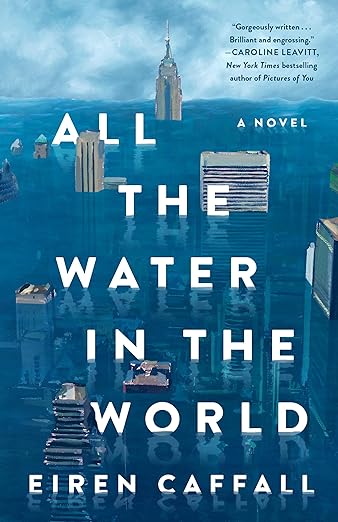
All the Water in the World is told in the voice of a girl gifted with a deep feeling for water. In the years after the glaciers melt, Nonie, her older sister and her parents and their researcher friends have stayed behind in an almost deserted New York City, creating a settlement on the roof of the American Museum of Natural History. The rule: Take from the exhibits only in dire need. They hunt and grow their food in Central Park as they work to save the collections of human history and science. When a superstorm breaches the city’s flood walls, Nonie and her family must escape north on the Hudson. They carry with them a book that holds their records of the lost collections. Racing on the swollen river towards what may be safety, they encounter communities that have adapted in very different and sometimes frightening ways to the new reality. But they are determined to find a way to make a new world that honors all they’ve saved.
Inspired by the stories of the curators in Iraq and Leningrad who worked to protect their collections from war, All the Water in the World is both a meditation on what we save from collapse and an adventure story—with danger, storms, and a fight for survival. In the spirit of From the Mixed-Up Files of Mrs. Basil E. Frankweiler and Parable of the Sower, this wild journey offers the hope that what matters most – love and work, community and knowledge – will survive.
My Review
I don’t want to be pedantic, but the description is somewhat misleading. Yes, some of the story does take place at the Natural History museum that the characters have lived at for 8 years, but the devastating storm comes at the very beginning of the narrative. That being said, the chapters shift between vignettes of life at the museum and the present-day survival story as the small group travels north to an uncertain future.
So, if you’re expecting a linear story of a community rebuilding itself in a post-apocalyptic world only to be met with a second reckoning, then this isn’t it.
But I really hope you stay for one of the best books I’ve read in a long time. Narrator Nonie offers such a fresh and original voice. She’s a young teen; she doesn’t present as precocious or preternaturally intelligent, but there is such a weariness to her voice, likely due to her entire worldview being shaped by growing up in the “after” of climate change.
Speaking of which, the book doesn’t have to be heavy-handed with the dire future to get its point across. But I digress…
Nonie has very few memories of her life in NYC before they moved to the museum. She seems to adapt much more quickly to changes in circumstance than her sister who is only three years older. I’m not a psychologist, but this is probably because Bix spent three more years living a “normal” life before they had to move to the museum. So Bix had more adapting to a new life, as opposed to Nonie, who was only around six when her life changed. Naturally, individual personalities also affect adaptability.
I would absolutely recommend All the Water in the World. This book had me riveted for every step of the journey the characters undertake. I was nervous about situations like the ones in The Road, which I am too much of a scaredy-cat to read. While there is certainly a lot to be wary of, it’s not horror after horror for our intrepid band. I was equally fascinated by the vignettes of museum life, although those are mostly bittersweet.I hope Caffall writes more fiction in the future.
I received a digital ARC of this book from St. Martin’s/NetGalley.
 "You Have Your Hands Full!"