Book Description
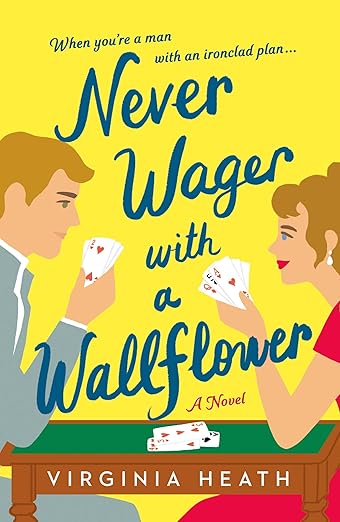
Never Wager with a Wallflower is the third and final delightful installment in Virginia Heath’s Merriwell Sisters Regency rom-com series.
Miss Venus Merriwell has been waiting for her prince to come since the tender age of fourteen. She wants a man who is a selfless academic like her, and free from all the wretched vices her gambler father enjoyed far too much before he left the Merriwell sisters practically destitute. Unfortunately, after a slew of romantic disappointments, there is still no sign of that prince at twenty-three and the only one true love of her life is the bursting-at-the-seams orphanage in Covent Garden that she works tirelessly for. An orphanage that desperately needs to expand into the empty building next door.
For Galahad Sinclair, gambling isn’t just his life, it’s in his blood. He grew up and learned the trade at his grandfather’s knee in a tavern on the far away banks of the Hudson in New York. But when fate took all that away and dragged him across the sea to London, it made sense to set up shop here. He’s spent five years making a success out of his gaming hall in the sleazy docks of the East End. Enough that he can finally afford to buy the pleasure palace of his dreams—and where better than in the capital’s sinful heart, Covent Garden? The only fly in his ointment is the perfect building he’s just bought to put it in also happens to be right next door to the orphanage run by his cousin’s wife’s youngest sister. A pious, disapproving and unsettling siren he has avoided like the plague since she flattened him five years ago.
While Venus and Galahad lock horns over practically everything, and while her malevolent orphans do their darndest to sabotage his lifelong dream, can either of them take the ultimate gamble—and learn to love thy neighbor?
My Review
I have been a big fan of Regency era romances for over 20 years, and Virginia Heath has always been on my radar, but I haven’t read very many of her books. I did read the first book in this series, but missed the second one.
Heroine Venus has been saddled with a name that leads (unsavory) men to assume that she is amorous as her namesake, the goddess of love. This could not be further from the truth, and after a devastating disappointment several years before the book begins, Venus has decided that she is not going to look for love, and will settle for an academic aristocrat who seems to tolerate her presence, although he shows no signs of affection.
Naturally, Venus clashes with happy-go-lucky Galahad, who has made a fortune on gambling. Their already tenuous relationship is thrust into outright animosity when they both believe that they have a rightful claim to the same building: Venus needs to expand her beloved orphanage and Galahad has found the perfect spot for his newest gambling venture.
This is a delightful take on the enemies to lovers trope. Their banter never fails to amuse, especially in the beginning when they are not very fond of each other… although it’s clear that Galahad has always been intrigued by Venus. The romantic pair is supported by a strong cast of secondary characters, many of whom appear in earlier books. Of course, the real stars of the proverbial show are a pair of scrappy orphans.
I enjoyed the diary entries at the beginning of each chapter. They are dated years before the events of the chapter, but they are chronological in nature, and give a great deal of insight into Venus’ character and her growing disillusionment with men.
There was a bit too much of an emphasis on Venus’ body. While waifish heroines were the norm for far too long, times have changed, and being voluptuous is no longer the novelty it once was. While we certainly want to see heroes appreciating their heroines, Galahad was prone to ogling far too often. However, this is forgivable because he is much more of a gentleman than many of the peers around him, and he accepts and supports Venus.
I would recommend Never Wager with a Wallflower. This was a sweet and tender story featuring memorable characters. This is the third book in a series, but it functions well enough as a standalone.
I received a digital ARC of this book from St. Martin’s/NetGalley.
 "You Have Your Hands Full!"